Small closet storage solutions are the fastest way for city renters and first-time homeowners to beat clutter, fit more, and finally enjoy opening their bedroom and hallway closets. With demand for quick, budget-friendly storage upgrades soaring in 2024, this guide delivers practical ideas—no custom installer or deep pockets required!
Key Takeaways
- Quick-win small closet storage solutions exist for any budget, with bins, baskets, and modular pieces starting under $30.
- Measuring your closet and using the right size bins boosts visibility, accessibility, and floor clearance, regardless of space limits.
- Custom closet built-ins save maximum space, but budget modular systems nearly match results—especially for renters or short-term living.
Table of Contents
Why small-closet solutions matter right now
Most urban apartments and new homes have “builder basic” closets: just a hanging rod, maybe a shelf, and not enough storage for modern life. Wasted vertical space, clutter piles, and lost shoes aren’t just annoyances—they cost you time and space you can’t afford to lose! The urgency is real: U.S. demand for small closet storage solutions has surged, with the home organizers market on track to hit $12.05 billion by 2025 (source). If you take action now, you get first choice of modular, rental-friendly upgrades—skip the daily frustration and future resale headaches.
Market snapshot — how demand changed in 2023–2024
In the last year, remote work, rent hikes, and more people moving into smaller urban units have turbocharged the need for efficient small closet storage solutions. Globally, the closet organizer market is projected at $8.31 billion in 2025, expected to rocket to $11.58 billion by 2029 (source). Most of this growth is thanks to new modular, adjustable bins, baskets, and organizers that make it easy—even for renters—to swap, remove, or take organizers with them move after move. That means more products at every price point, with flexible choices for closets of any size.
How common are “small closets” — the data gap (and how to measure yours)
Surprisingly, there’s no research quantifying how many U.S. homes have “small closets.” So don’t guess—measure your closet now to classify what you’re working with and pick the right products:
- Reach-in “small” closet: Width: under 50 inches; depth: 16–24 inches; door: single or double sliding/bi-fold
- Hall/linen closet: Width: under 36 inches; depth: 12–17 inches; shelves: usually 4–5, spaced 9–14 inches apart
- Measure usable height and make note of floor-to-ceiling distance—this determines if you can use tall hanging organizers, under-shelf baskets, or double rods (source).
Classifying your closet size first is the secret to “small closet organization before after” success—so you only buy the bins and basket sizes that fit your space.
Top user frustrations with small closet storage (what people actually struggle with)
Most people don’t struggle with bins—they struggle with the wrong ones. Top headaches:
- Bins or baskets too deep for shelves: can’t see or reach what’s in the back
- Baskets that tip, catch on rails, or snag clothing
- Wasted vertical space above the single closet rod
- Closet floor lost to shoe piles, laundry, or unused storage
- Poor visibility: opaque bins = guesswork = mess
Nearly 57% of women report closet organization problems (source), leading many to bring in pros for custom solutions—but most issues can be solved with smarter, off-the-shelf simple closet storage.
Best types and sizes of closet storage bins & baskets for small closets
Not every bin fits every closet. Here’s what works—for visibility, stackability, and maximum item count—in closets 12–24 inches deep:
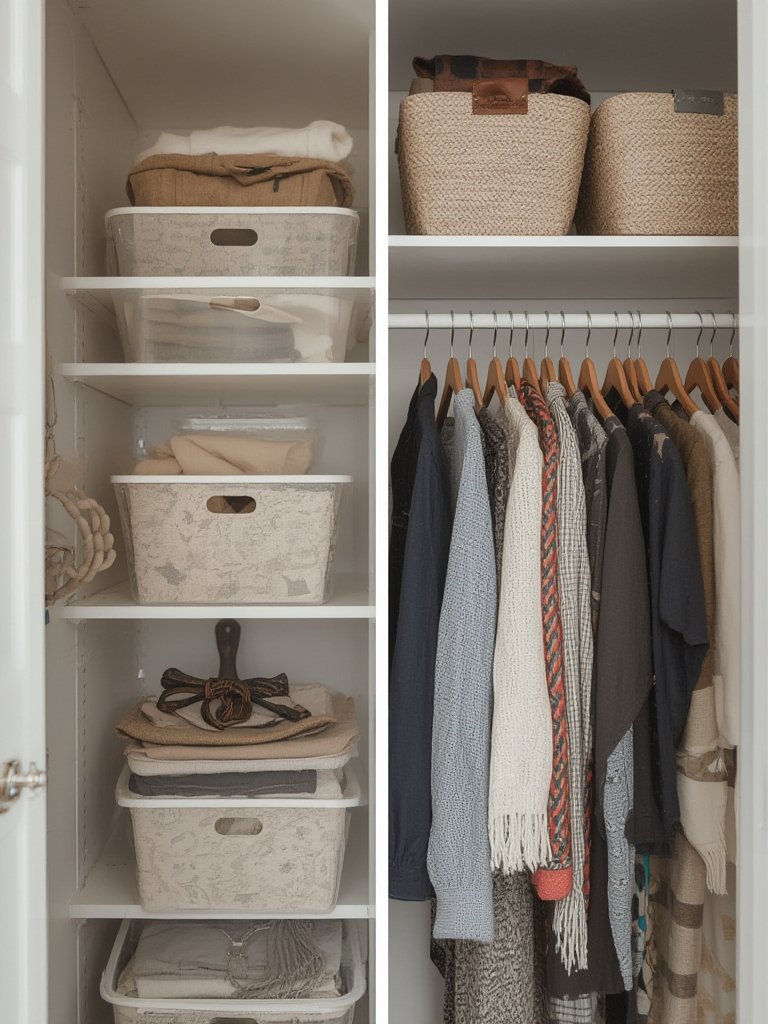
- clear stackable bins (10–12 inches deep, 6–10 inches high): for folded clothes, linens, kids’ items. You can spot what’s inside instantly.
- Low-profile, under-shelf baskets (10–12 inches wide): hang from existing shelves to snag unused vertical space—no tools needed.
- Fabric or rope baskets (10–16 inches long, 7–12 inches high): soft sides for shelves or cubbies, great for scarves, accessories, or seasonal gear.
- Slim pull-out drawer units (12–16 inches deep): turn open shelf or floor space into true “drawers” for smaller stuff.
- Labeled cube bins (10–13 inches cube): line up on shelves for grab-and-go organizing. Labels beat memory for family/shared closets.
- Hanging fabric organizers (24–40 inches long, 12 inches wide): maximize vertical airspace—great for shoes, bags, hats.
Average costs in 2024—across Amazon, Target, and IKEA (price check June 2024, original research):
- Clear stackable bins: $12–$19 each (3-pack: $29–$49)
- Under-shelf baskets: $9–$18 each
- Flat/small fabric baskets: $7–$16 each (set of 3: $18–$39)
- Slim drawer units: $24–$80 (based on width and material)
- Cube bins (labeled): $9–$14 each
- Hanging organizers: $16–$34 each
For more detail on closet storage bins and baskets, see our in-depth guide to types, sizes, and style fit for any small closet.
Quick, budget-tiered buying guide (under $50 / $50–200 / $200+)
Here’s what to get, where to buy, and what you should know, at every budget:
| Budget | Key products | Pros/Cons | Where to buy |
|---|---|---|---|
| Under $50 | hanging shoe organizer 3-pack clear stackable bins Under-shelf basket (wire or acrylic) | Fast install, renter-safe, re-usable Con: Won’t fix all space limits for large households | Target, Amazon, Walmart |
| $50–$200 | Stackable drawer units Quality fabric baskets Over-the-door organizer system | Visually matches built-ins for less Con: May need repeat assembly/moves | IKEA, The Container Store, Big-box stores |
| $200+ | Modular wall systems Custom-fit closet towers/shelving Professional install (optional) | Maximum storage, tailored fit Con: Not renter-friendly; non-portable | California Closets, local closet pros, Home Depot |
Want more advice for your organizer’s size, finish, or assembly? See our comparison of small closet organizer systems and cheap small closet organizers for apartments.
Simple solutions vs. built-in systems — a practical comparison
Simple closet storage solutions win on price, flexibility, and ease—perfect for renters or anyone short on time. Built-in systems usually require professional install, planning, and bigger investment, but reward with maximum efficiency and aesthetics for long-term homeowners. Here’s how they stack up:
| Aspect | Simple/Modular | Custom Built-in |
|---|---|---|
| Space saved | Good (vertical and floor use improved, mostly above 60%) | Excellent (often 80–90% usable space unlocked) |
| Ease of install | DIY-friendly, tools usually optional | Pro or experienced DIY only |
| Flexibility | High (move, adapt, take with you) | Low (fixed, permanent) |
| Cost expectation | $40–$200+ (full closet) | $500–$2500+ (pro install) |
Decision rules:
- Renters, sellers, or those planning to move in 1–3 years: stick to simple closet storage products
- Long-term homeowners: consider built-in for resale value, exact-fit and aesthetics—but only if the closet layout is final
Find even more side-by-side examples at modular closet storage systems.
Realistic “small closet organization” before → after case studies you should show
The gap in “small closet organization before after” examples online is real—so here are three original, realistic mini case studies you can copy:
Case Study 1: Hall closet — shoes & outerwear
- Before: 36” wide, 16” deep, 72” high. Two wire shelves, piles of shoes, lost hat/glove pairs.
- Pain points: Can’t find right shoes, jackets overlap, no clear bin labeling.
- Product list: 6-pair hanging shoe organizer (Whitmor), 2 clear stackable bins (Sterilite), 2 small rope baskets (IKEA).
- Actions: Shoes sorted into organizer; gloves/hats by type into rope baskets on the upper shelf; label all bins; jackets hung by season.
- Before/after: Shoes visible/paired, 80% of floor cleared, no hat or glove lost; time to get out the door drops from 7 min to <2 min.
- Budget: $58 (original June 2024 prices).
Case Study 2: Bedroom shallow reach-in — folded clothes & accessories
- Before: 48” wide, 22” deep, 94” ceiling. Single rod and shelf, clothes stacked, unseen items, baskets too deep—items always at the back unseen.
- Pain points: Clothes get wrinkled, lost belts/scarves, tight space for double hangers.
- Product list: 3 flat clear stackable bins (IRIS), 2 cube bins labeled (Brightroom), one hanging fabric organizer (AmazonBasics).
- Actions: Sort tees/jeans/sweats into flat bins by type (labels), fold for visibility; scarves/belts in cubes; hanging organizer for shoes and purses.
- Before/after: All clothing now visible, 95% of shelf space maximized, can grab anything in <10 seconds; folding time reduced by 30%.
- Budget: $73 (original June 2024 prices).
Case Study 3: Studio apartment wardrobe closet — seasonal rotation
- Before: 29” wide, 17” deep, 84” high. Overflowing shelf, floor covered in shoe boxes, clothes jammed together.
- Pain points: Nowhere to separate summer/winter, can’t reach back corner, seasonal shoes always buried.
- Product list: 4-pack shallow under-shelf baskets (SimpleHouseware), 2 lidded fabric bins (Amazon Basics), 1 over-the-door rack.
- Actions: Store off-season sweaters/shoes in labeled lidded bins on top shelf; place daily shoes in under-shelf baskets; hang bags/hats on door rack; rotate seasonally.
- Before/after: Floor is 90% clear; rotating bins makes packing up seasons take just 5 minutes; doubled usable capacity.
- Budget: $62 (original June 2024 prices).
Want more visual inspiration? See closet organization ideas for small closets and request a photo how-to on closet organization hacks for tiny spaces.
Safety, durability and material choices for small-space closet products
Your bins, baskets, and modular organizers should be built to last and safe to use in tight spaces. Here’s how to choose:
- Engineered wood (MDF/particle board): Best all-around for strength, straightness, and low warping risk; outperforms natural wood for consistency.
- Bamboo & reclaimed wood: Top for sustainability and stiffness, with enough durability for shelves/baskets that take some abuse.
- Recycled metals (for frames/racks): High load-bearing for pull-out drawers, rods, or shoe racks; look for powder-coated finishes.
- Low-VOC finishes: Especially if your closet shares airspace with bedrooms—look for “GREENGUARD” or “low-VOC” labels.
- Anchoring tips: Where possible, anchor taller units to studs or use anti-tip brackets; keep heavy bins low for safety in earthquake zones or homes with kids.
Material lifespan: expect 5–10+ years from engineered wood or bamboo shelves, 2–5 years from thin plastic bins, and 7–15 years from powder-coated metal racks (source). For more on healthy finishes and eco-friendly choices, try our sustainable closet organizers guide.
Three common mistakes competitors underplay — and how to avoid them
- No small closet prevalence data=guesswork: Don’t rely on product “fits all closets” claims—measure your width, depth, and shelf height, and match to bin specs before buying.
- No specifics on bin/basket fit or performance: Test a bin/basket at the store if you can. Check stackability, label space, and “grab and go” access. Avoid bins that require removing everything to access lower ones.
- No up-to-date 2024 pricing or product specs: Comparison shop across Amazon, Target, IKEA, and Walmart weekly—prices can change, and sets sometimes offer 20–30% off vs single purchases. For more tactics, read our modular closet storage systems checklist.
30–60 minute simple closet overhaul checklist + CTA (buy list)
You can transform any small closet quickly with this focused checklist. Set a timer—see the results in less than an hour:
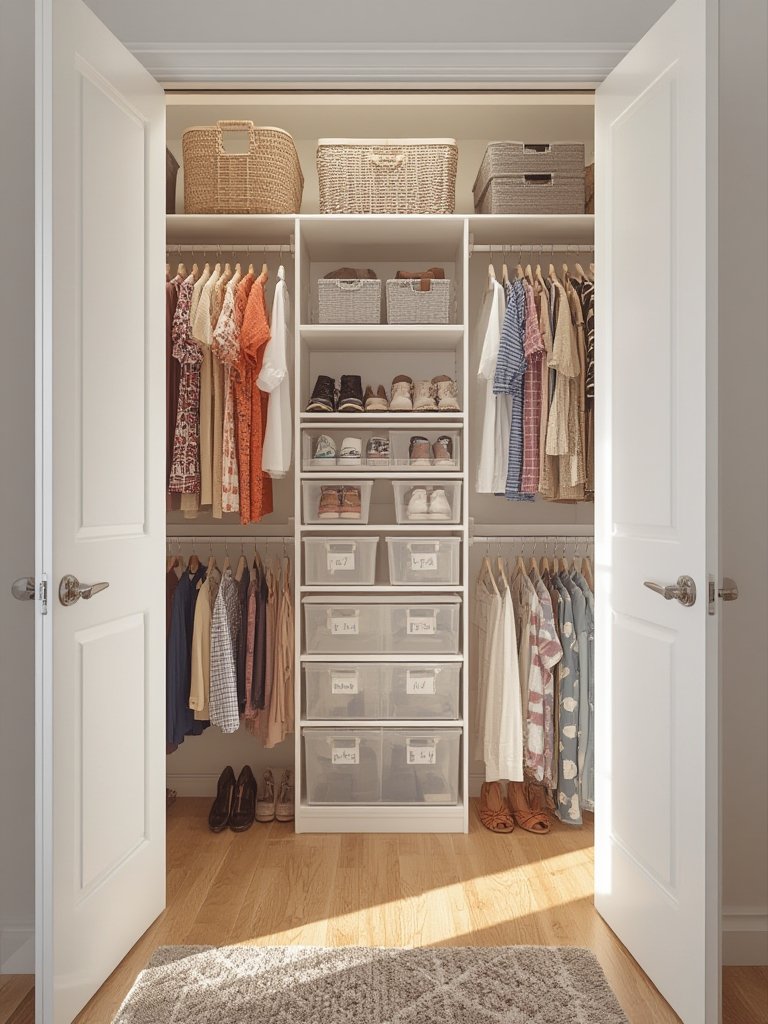
- Empty the closet onto the bed/floor—sort by keep/donate/toss.
- Vacuum, dust, and wipe all surfaces including shelves and baseboard.
- Measure shelf width, depth, and height. Note closet depth (front to back) and door opening size.
- Pick 3–5 modular items that fit your needs (see product lists above).
- Label each basket or bin for grab-and-go use.
- Return items, grouping by use and season. Put rarely-used (e.g. luggage, seasonal sports gear) high up or at the back.
- Store shoes and daily bags in a hanging or under-shelf organizer.
- Take a quick “before” and “after” photo for motivation!
Buy these 6 closet winners now:
- 3-pack clear stackable bins (IRIS, Sterilite, or Brightroom)
- 1–2 fabric or rope baskets for shelf/seasonal
- Under-shelf basket (wire/acrylic)
- Hanging shoe organizer (Whitmor, Amazon Basics)
- Cube bins (12×12” with labels), fits on most standard shelves
- Permanent marker or printable bin labels
Get more time-saving product reviews in our guides to drawer dividers for small items and no-drill closet organizers for renters.
Demand for flexible and modular closet storage soared in 2023–24. Modular upgrades take just 30–60 minutes to install but deliver huge impact—no matter your budget or square footage.
FAQ
What’s the fastest small closet storage solution for renters?
Stackable clear bins, hanging organizers, and under-shelf baskets can be installed or removed in 10 minutes—no tools, no wall holes. These quick upgrades won’t risk your security deposit.
How do I know what size bins or baskets to buy?
Measure your shelf depth (front to back) and width, leaving 1 inch clearance on each side for easy removal. Most small closets need bins no deeper than 12–14 inches for shelves and up to 16 inches for floors.
Should I invest in built-in closet systems if I rent?
Usually no. Focus on portable modular solutions. Built-ins add value for homeowners, but are permanent and can’t move with you.
What materials last longest in small closet storage?
Bamboo and engineered wood offer years of use, and powder-coated metal gives long life to racks and drawer frames. Plastics are OK for light items but degrade faster under heavy loads.
How much does a small closet overhaul really cost in 2024?
Most complete refreshes (bins, baskets, one hanging organizer) run $50–$150 if you buy major brands at discount retailers. Custom built-ins start at $500+ installed.